
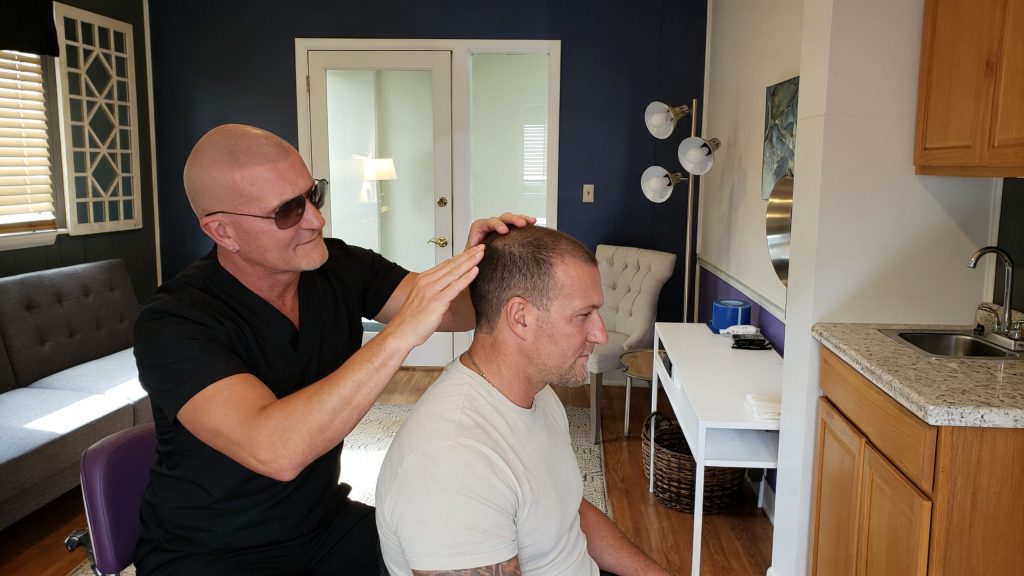
You’ve still got hair, but it’s thinner than it used to be and no amount of styling seems to hide it anymore. Male density SMP is one of the most effective ways to restore the appearance of fullness without shaving your head. The best SMP density technique for your situation depends on your hair colour, texture, and thinning pattern. Here’s a breakdown of the techniques that actually make a difference, and which one might be right for you.
1. Stippling: the foundation of every good density session
Stippling is the core technique behind almost all advanced micropigmentation methods used in density work. A fine needle deposits individual pigment dots into the upper dermis, each one mimicking a follicle sitting just beneath the scalp surface. The dots are placed with deliberate spacing, so the result reads as natural density rather than a solid fill.
For men with mild to moderate thinning across the crown or temples, stippling alone can be transformative. The key is dot size. Too large and the result looks heavy and unnatural. Too small and the coverage is too light to register visually. Getting that balance right is what separates a skilled SMP artist from someone just going through the motions.
2. Pointillism: precision for fine or light-coloured hair
Pointillism takes stippling to a more refined level. The dots are placed with greater intentionality around their size variation, spacing, and directional clustering, creating the impression of natural hair growth patterns rather than uniform coverage. It’s particularly effective for men with fine or light-coloured hair, where a flat, even dot pattern would look out of place.
Real hair doesn’t grow in a perfectly even grid. Pointillism replicates the slight randomness of natural follicle distribution. If your hair is blonde, light brown, or grey, this technique is usually the better fit because it avoids the too-uniform look that can give density tattoo techniques away.
3. Layered blending: the go-to for diffuse thinning
Diffuse thinning, where hair thins evenly across a wide area rather than receding from a defined point, needs a different approach. Layered blending builds coverage in multiple passes, with each layer sitting at a slightly different depth and density. The result is a gradual transition from thinner areas to fuller-looking areas that’s almost impossible to detect at conversational distance.
This technique works especially well for men dealing with thinning across the mid-scalp. Rather than targeting one patch, layered blending treats the scalp as a whole, creating a consistent baseline of density that ties everything together. It typically requires two to three sessions to build to the right depth.
4. Hairline feathering: softening the edge for density work
Even when the goal is density rather than a new hairline, the front edge matters. Hairline feathering uses micro-fine dots placed with decreasing density as you move toward the forehead, creating a soft, natural-looking transition rather than a hard line. Without it, even excellent density work in the crown can look disconnected from the front.
This technique is particularly important for men who style their hair forward or to the side, since any inconsistency at the hairline becomes more visible. Feathering doesn’t add a new hairline; it simply ensures the density treatment integrates seamlessly with whatever hair you already have at the front.
5. Scar concealment layering: for men with transplant scars
A significant number of men seeking density SMP have already been through one or more hair transplant procedures. Strip surgery in particular leaves a linear scar along the back of the head, and FUE leaves small circular punch marks. Standard density techniques don’t always sit well over scar tissue because the skin texture is different and pigment can behave unpredictably.
Scar concealment layering uses a slower, more deliberate pigment-building process that accounts for how scar tissue absorbs ink differently. Multiple light passes are used rather than saturating the area in one go. The goal is to match the surrounding scalp tone closely enough that the scar blends into the surrounding density. For men who want to wear their hair short without worrying about what’s visible at the back, this technique is often the piece of the puzzle that finally makes that possible.
The right SMP density technique isn’t a one-size-fits-all call. Your hair colour, texture, thinning pattern, and skin type all shape which approach will give you the most natural result. A thorough consultation that actually looks at these factors is the starting point for getting it right.
Frequently Asked Questions
What is the best SMP density technique for men who still have hair?
The best SMP density technique for men with existing hair depends on the thinning pattern. Stippling and pointillism suit defined thinning zones, while layered blending works better for diffuse thinning across a wider area. A skilled practitioner will assess your hair colour, texture, and thinning pattern before recommending a method.
How many sessions does male density SMP typically require?
Most male density SMP treatments require two to three sessions, spaced around ten to fourteen days apart. Layered blending techniques often need the full three sessions to build sufficient depth. Each session allows the skin to settle and the practitioner to refine coverage before adding more pigment on top.
Will SMP density work look natural if my hair is grey or light-coloured?
Yes, but technique selection matters significantly. Pointillism, which varies dot size and spacing to replicate natural follicle randomness, tends to suit grey and light-coloured hair better than flat stippling. Pigment shade matching is equally important, and a good SMP artist will mix custom tones rather than using an off-the-shelf colour.
Can density SMP cover hair transplant scars at the same time?
Yes. Scar concealment layering is a specialised approach within advanced micropigmentation methods that builds pigment gradually over scar tissue, which absorbs ink differently from healthy skin. It’s often combined with broader density work in the same treatment plan, so the scar blends into the surrounding scalp rather than standing out against it.
Does male density SMP require shaving the head?
No. Male density SMP is specifically designed for men who want to keep their existing hair. The pigment dots are worked into the scalp beneath your natural hair, adding the visual appearance of fuller coverage. Unlike a traditional hair tattoo for a shaved-head look, density SMP works with your current hair length and style.