
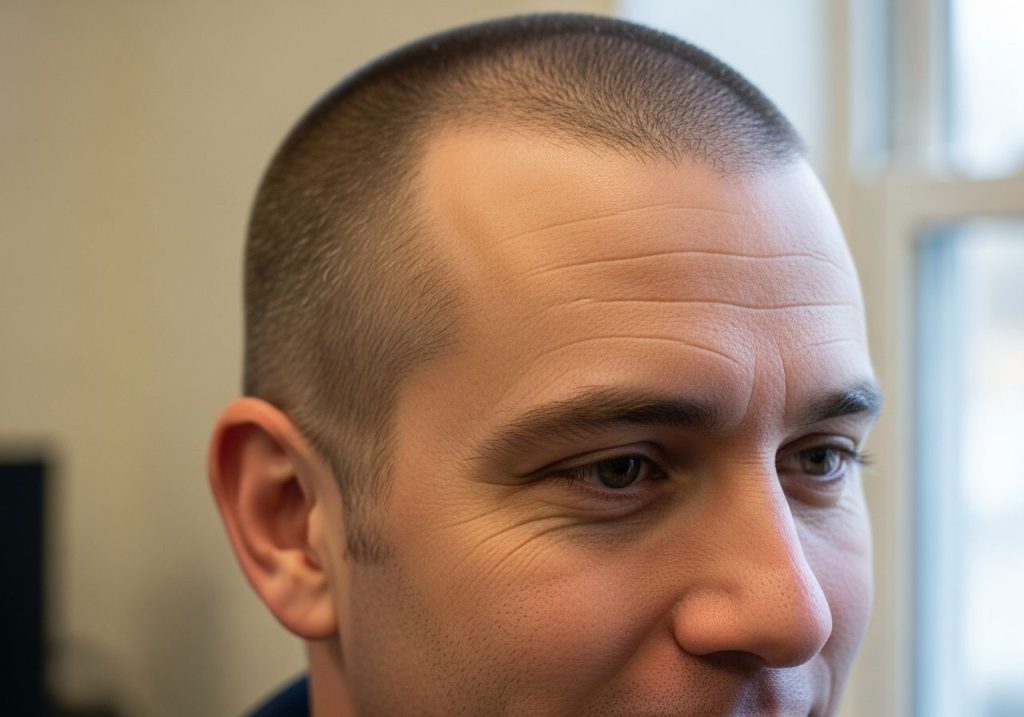
You’ve accepted the hair loss. Now you’re weighing up your options and wondering whether surgery is really worth it, or whether SMP for a shaved look is the smarter move. This article puts both routes side by side, honestly, covering cost, downtime, candidacy and longevity. By the end, you’ll know which one fits your situation.
What each option actually does to your scalp
SMP — scalp micropigmentation — deposits medical-grade pigment into the upper layer of your scalp using a precision needle device. The result is thousands of tiny dots that replicate the appearance of a freshly shaved head. It does not stimulate hair growth, and it is not trying to. It creates an optical illusion of density and a defined hairline on a scalp that is already smooth or closely cropped.
A hair transplant, by contrast, is surgery. A surgeon harvests follicles from a donor area at the back or sides of your scalp and implants them where thinning has occurred. Strip surgery (FUT) leaves a linear scar across the donor zone. FUE harvests individual follicles and leaves dot-shaped scarring. Either way, living tissue is being moved, and the outcome depends heavily on how much donor hair you have left to work with.
The key distinction: SMP gives you the look of a shaved head, while a transplant attempts to give you growing hair. These are genuinely different goals, and the right choice depends on which one you are actually after.
Who is a good candidate for each route
SMP works for almost any man dealing with hair loss: male pattern baldness at any stage, alopecia areata, scarring from previous surgery, or a scalp with low donor density. Because it works with the scalp as it is right now, it is not limited by how much hair remains. Men who are fully bald, or close to it, are often the strongest candidates.
Hair transplant candidacy is more restrictive. You need sufficient donor hair, realistic expectations about density, and a hair loss pattern that has largely stabilised. If you are in your twenties with aggressive, ongoing loss, most reputable surgeons will ask you to wait. Transplanting hair into an area that continues to thin around the grafts leads to an unnatural result over time, producing patchy islands of transplanted hair surrounded by bare scalp.
There is also the scar question. If you have already had FUT surgery, you have a linear scar that a short or shaved style will expose. SMP can camouflage that scar by replicating follicle dots across it, which is one of the reasons men who have been through multiple transplant procedures sometimes turn to SMP as a finishing step. Many men have followed exactly that journey: multiple strip and FUE surgeries over more than two decades, with the resulting scars making short styles feel off the table until SMP offered a solution.
Cost, downtime and the long-term mathematics
Hair transplant surgery in the United States typically runs from around $4,000 to $15,000 or more, depending on the number of grafts, the technique used and the clinic’s location. That is a single-procedure cost, but many men return for a second or third round in pursuit of the density they hoped for the first time. The post-operative recovery involves weeks of redness, scabbing and a shedding phase in which the transplanted hairs fall out before, hopefully, regrowing. Full results take 12 to 18 months to assess.
SMP for a shaved head is typically completed across two to four sessions, each lasting one to five hours and spaced several weeks apart. Total costs generally range from $400 to $5,000 depending on the area being treated and the practitioner’s level of experience. Aftercare is straightforward: keep the scalp dry for the first four days, avoid sun exposure and heavy sweating, and apply SPF daily once healed. Results are visible immediately after the first session, with the look building progressively as subsequent sessions add pigment density.
Longevity is where people sometimes underestimate SMP. Results typically hold well for three to six years before a touch-up is needed. Factors such as sun exposure, oily skin and faster cellular turnover can accelerate fading, while consistent SPF use extends the result. Touch-ups every four to six years are standard. Over a ten-year horizon, the cumulative cost of SMP with touch-ups is typically a fraction of what multiple surgical rounds cost.
The result you are actually living with day to day
A well-executed hair transplant, in the right candidate, can look genuinely natural. However, it requires committing to a longer hairstyle, ongoing medical treatment such as finasteride or minoxidil to protect the non-transplanted hair, and an acceptance that results depend significantly on surgeon skill and individual healing.
SMP for a shaved head commits you to a different but equally consistent look: a close-cropped aesthetic with a clean, defined hairline. You will keep the scalp closely shaved to match the pigment. The result is low-maintenance once healed, predictable and not dependent on continued hair loss progression. Because SMP works with a shaved or nearly shaved scalp rather than attempting to regrow hair, it sidesteps the main vulnerability of transplants, which is the rest of your hair continuing to fall out.
If you are drawn to the shaved or cropped look and want a result you can see within weeks rather than waiting 18 months for surgery to declare itself, SMP is worth taking seriously as a primary solution, not merely a backup plan.
Frequently Asked Questions
Does SMP on a shaved head look natural up close?
Yes. When performed by an experienced practitioner, SMP closely replicates the appearance of a shaved scalp at normal social distances and up close. The key is matching pigment tone to your natural hair colour and building dot density progressively across sessions. Poor technique from undertrained practitioners is the main cause of unconvincing results.
Can SMP and a hair transplant be used together?
Yes, and this combination is more common than people expect. Men who have had transplant surgery often use SMP to camouflage donor scarring, fill in areas where transplanted grafts did not achieve full density, or create a sharper hairline. SMP can also add the visual impression of density between existing transplanted hairs, improving the overall result significantly.
How many SMP sessions does a shaved head treatment typically need?
Most men need two to four sessions for a shaved head SMP result. Each session builds pigment density progressively, starting at around 40 dots per square centimetre and increasing to 80 to 100 dots in later sessions. Sessions are spaced several weeks apart to allow healing and accurate assessment of how the pigment has settled.
Is hair transplant surgery worth it if you prefer a shaved look anyway?
Generally, no. Hair transplant surgery is designed for men who want growing hair and a longer hairstyle. If your preferred look is a closely shaved scalp, SMP delivers that result directly, at lower cost, with less downtime and without the surgical risks or 12 to 18 month wait for a final result. The two options serve genuinely different goals.
How long does SMP last compared to a hair transplant?
SMP typically lasts three to six years before a touch-up is needed, with fading influenced by sun exposure, skin type and aftercare habits. A hair transplant, if successful, grows hair permanently, but the non-transplanted surrounding hair continues to thin, often requiring further surgery or medical treatment. Both options involve ongoing maintenance costs over time.