
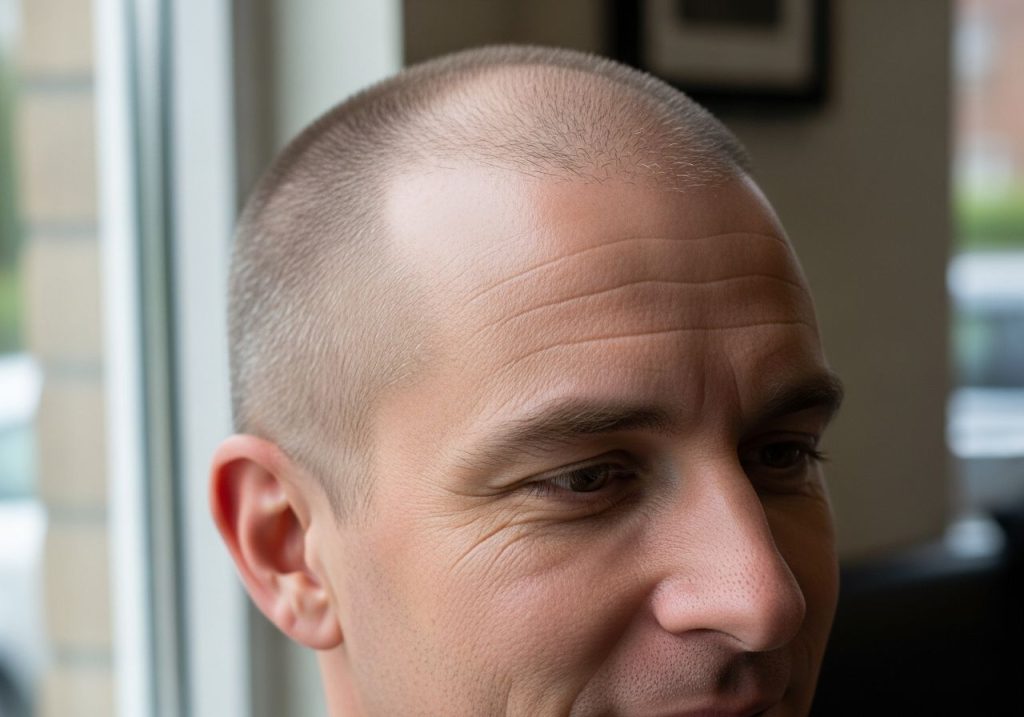
You’ve got thinning hair, you’ve researched hair transplants, minoxidil and finasteride, and you keep landing on the same question: would SMP actually work for someone like you? It’s a fair thing to want answered before you sit in a consultation chair. This article breaks down exactly who benefits most from male density scalp micropigmentation, and who should hold off, so you can self-qualify before booking anything.
The honest answer is this: a good candidate for male density SMP is a man with stable thinning or pattern hair loss, healthy scalp skin, and realistic expectations about what pigment can and cannot do. It doesn’t regrow hair. It never will. What it does is rebuild the illusion of density by adding thousands of tiny pigment deposits between your existing strands, so the scalp reads as fuller and darker rather than pink and exposed.
1. You’ve got diffuse thinning rather than total baldness
Male density SMP works best on men who still have hair, just not enough of it. If you’re at the stage where your scalp is visible through your hair under bright light, especially at the crown or through the mid-scalp, that’s exactly the territory this treatment is built for.
The pigment gets added between your existing follicles, matched to your natural hair colour, so the contrast between scalp and hair drops dramatically. Men with Norwood stage 3 to 5 pattern loss tend to see the most convincing results because there’s still a framework of real hair for the pigment to blend into.
2. Your hair loss has stabilised, not actively progressing
This one matters more than most men expect. If your hair loss is still accelerating month to month, particularly from active alopecia areata or alopecia totalis, an SMP artist has no stable canvas to work with. The pattern you tattoo today could look wrong in six months if more hair disappears around it.
Practitioners generally want to see that your loss has settled, often confirmed alongside a dermatologist, before committing to a density pattern. Men on finasteride or minoxidil who’ve maintained a steady baseline for a year or more are usually in a strong position.
3. Your scalp skin is calm and healthy
Active scalp conditions are one of the clearest reasons a scalp micropigmentation treatment plan gets paused. Psoriasis flare-ups, eczema, and active acne on the scalp all interfere with pigment retention and healing, and needling inflamed skin isn’t safe practice.
Keloid-prone skin is a separate concern. If you scar heavily or raised from minor cuts, that needs discussing openly at consultation, because the micro-injuries from pigmentation carry a small risk of triggering the same response.
4. You understand this is camouflage, not regrowth
SMP does not regrow hair, stimulate follicles, or reverse the biology behind male pattern baldness. It’s a cosmetic technique that deposits pigment at the epidermal to upper dermal layer, roughly 1.5 to 2 millimetres deep, using a needle cycling around 100 to 150 times per second to build a stippled, follicle-like pattern.
Men who go in expecting thicker, growing hair are setting themselves up for disappointment. Men who go in wanting the visual density of a close crop or a fuller-looking head, with the scalp-to-hair contrast gone, are the ones who walk away genuinely happy with the result.
5. You’re not expecting a one-session fix
Realistic candidates understand the process takes time. Most men need two to four sessions, spaced several weeks apart, with dot density increasing session by session from around 40 dots per square centimetre early on up to 80 or more in the final pass. Each session can run one to five hours depending on the area covered.
If you’re hoping for a single afternoon appointment and a finished look, that expectation needs recalibrating. The layered approach is what makes the final density look natural rather than flat or uniform.
6. You’re prepared for the aftercare window
Good candidates also need to be realistic about downtime. The first four days mean no water on the scalp, no shampoo, no sweating and no shaving. Days five to ten allow gentle washing but no sun exposure, and from day ten you can reintroduce SPF and normal grooming.
Swimming pools are off-limits for a full 28 days, and complete healing takes around a month. If your lifestyle or job makes that window genuinely impossible to manage right now, it’s worth timing your sessions around a quieter stretch rather than skipping the rules.
If you’ve read through those six points and mostly nodded along, you’re likely in good shape to start a consultation conversation. If a couple of them gave you pause, that’s not a dead end, it just means addressing the scalp condition, stabilising the hair loss, or resetting your expectations before moving forward.
Frequently Asked Questions
Who is a good candidate for male density SMP?
A good candidate has diffuse thinning or pattern hair loss that has stabilised, healthy scalp skin free of active conditions, and realistic expectations that SMP creates the appearance of density rather than regrowing hair. Men in Norwood stages 3 to 5 typically see the most natural-looking results.
What are the main SMP density contraindications for men?
Key contraindications include active alopecia areata or totalis, unmanaged psoriasis or eczema flare-ups, active scalp acne, and keloid-prone skin. Hair loss that’s still actively progressing is also a concern, since the pigment pattern needs a stable base to look right long term.
When is scalp micropigmentation not suitable for someone?
Scalp micropigmentation isn’t suitable for men with active, unstable hair loss, inflamed or infected scalp skin, or those expecting the treatment to regrow hair. It’s also not ideal for anyone unwilling to follow the 28-day aftercare and healing window.
Does male density SMP work on all stages of hair loss?
It works best on early to moderate thinning and pattern loss where some existing hair remains to blend with the pigment. Men with complete baldness can still get strong results, but the approach shifts to replicating a shaved head look rather than adding density between strands.
How long does male density SMP last before needing a touch-up?
Results typically last four to eight years before noticeable fading, though this varies with skin type, sun exposure and skincare habits. Most men return for a touch-up every four to six years to keep the density looking sharp and consistent.
Ready to talk it through?
Carolina Scalp Center in Raleigh offers a personal consultation to answer your questions and recommend the right approach for you. Get in touch with Carolina Scalp Center to book your consultation.