
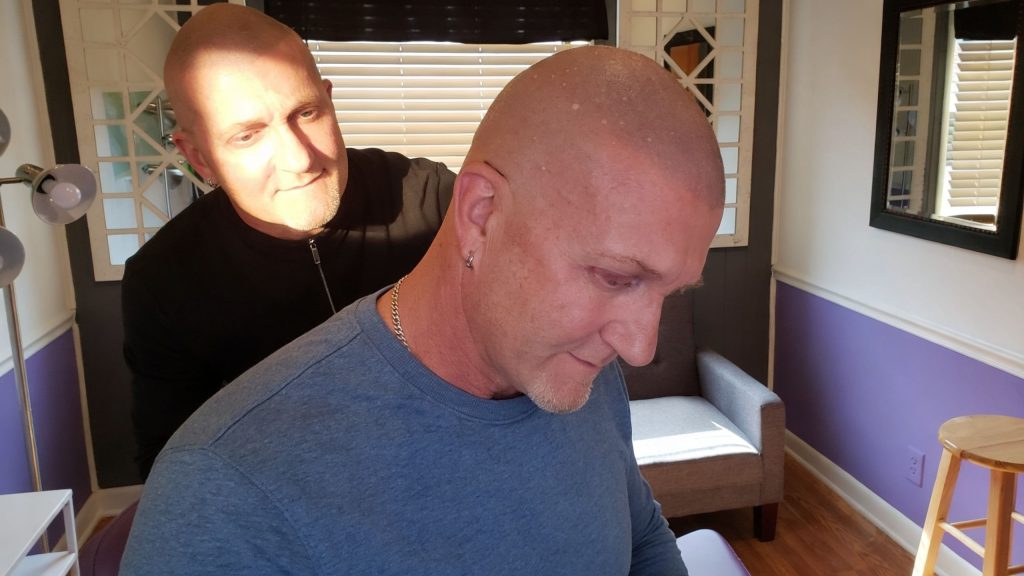
You’ve had an FUE transplant, and now you’re noticing those small, pale dots scattered across your donor area. Subtle in some lights, obvious in others, they’re stopping you from wearing your hair short. This article explains exactly what SMP can do for those dots, what realistic results look like, and what makes the process trickier than most people expect.
Why FUE dot scars respond well to SMP concealment
Of all the scar types that scalp micropigmentation can address, FUE dot scars are generally the most straightforward to conceal. That’s not a guarantee. It’s a pattern, and understanding why it exists actually matters.
FUE harvesting leaves small, individual circular marks, typically 0.8mm to 1mm in diameter, spread across the donor zone at the back and sides of the scalp. Because each scar is tiny and isolated, a skilled SMP artist can work around and through them, depositing pigment dots that mimic the appearance of shaved hair follicles. Done well, the dots blend into the surrounding area and the visual contrast between scarred and healthy skin largely disappears.
The best results, roughly 85% coverage, happen on scars that are completely flat, fully healed, and have a skin texture and colour reasonably close to the surrounding scalp. If your FUE was more than 18 months ago and your donor area has settled, you’re in a solid position to explore this.
What scar tissue actually does to pigment retention
Here’s what a lot of clinics gloss over: scar tissue behaves differently to normal skin, and that unpredictability is real. Scar tissue tends to be denser and less vascular than healthy scalp skin, which affects how it absorbs and holds pigment.
In practice, this means pigment can fade faster in scarred areas, spread slightly differently, or simply not take as consistently as it does elsewhere on the scalp. Some dots will respond beautifully. Others may need additional passes in follow-up sessions to build depth and consistency.
This is precisely why FUE scar camouflage should only ever be performed by an SMP artist with specific experience in scar work. It requires a different touch, different needle selection in some cases, and the patience to build coverage gradually rather than overloading the tissue in one session. Rushing scar work is how you end up with uneven or blown-out results that are far harder to fix.
What the SMP process looks like for FUE scars
The process for concealing FUE dot scars with SMP follows the same broad structure as a standard scalp micropigmentation treatment, but with a few important nuances worth knowing about.
Your first session focuses on establishing a baseline: matching the pigment colour to your natural hair tone and surrounding scalp, then beginning to layer dots into and around the scarred tissue. Most clients need two to three sessions, spaced four to eight weeks apart, to reach the density and evenness that makes the donor area look uniform. Scar sessions are rarely a one-and-done job.
The goal isn’t to make the scarring invisible under a magnifying glass. It’s to create a consistent visual appearance at normal viewing distance, so that when you shave your head or keep your hair very short, the back of your scalp looks even rather than patchy. That’s an achievable outcome for most FUE scar patterns when the conditions are right.
It’s also worth knowing that SMP for FUE scars is often performed alongside broader scalp micropigmentation for density, where the same pigment technique is used across the full scalp or crown to create the appearance of a close-cropped head of hair. The two treatments work naturally together, and addressing both in the same plan usually produces the most seamless overall result.
Factors that affect your individual outcome
No reputable SMP artist will promise you 100% scar concealment, because that promise simply doesn’t exist. What they can do is give you an honest read of your specific situation before any needles come near your scalp.
A few things genuinely affect how well your FUE dot scars will respond. Scar age matters: fresher scars are less stable and should be fully healed before treatment begins. Texture matters: raised or pitted scarring is harder to work with than flat tissue. Skin tone matters: higher contrast between the scar and surrounding skin means more sessions to close that gap. And extraction density matters: a heavily harvested donor area with tightly packed dots creates a different challenge than a sparsely extracted one.
The honest reality is that most people with FUE dot scars see a genuinely meaningful improvement. The dots stop standing out. The donor area looks consistent. Short hairstyles become a real option again. For many people, that shift is significant, and it’s why FUE scar camouflage is one of the more satisfying treatments SMP can deliver.
Frequently Asked Questions
How long does SMP for FUE dot scars last?
SMP pigment in scar tissue typically fades a little faster than in healthy scalp skin, so you may need a touch-up session every three to five years. Sun exposure and your skincare routine both affect longevity. Keeping the area moisturised and using SPF when your scalp is exposed helps maintain the result for longer.
How soon after my FUE transplant can I get scar camouflage SMP?
You should wait at least 12 to 18 months after your FUE procedure before having SMP on the donor scars. The tissue needs to be fully healed, stable, and settled before pigment is introduced. Treating immature scar tissue increases the risk of unpredictable pigment retention and can compromise the final appearance significantly.
Will SMP completely hide my FUE dot scars?
Complete concealment isn’t a realistic expectation for any scar treatment, including scalp micropigmentation for FUE dot scars. Well-executed SMP on flat, fully healed scars achieves around 85% coverage, creating a visually consistent donor area at normal viewing distance. Most clients find the improvement substantial enough to confidently wear shorter hairstyles.
Does the SMP process hurt more on scar tissue?
Sensation varies between individuals, but scar tissue is often less sensitive than surrounding healthy skin because nerve endings can be disrupted during the original healing process. Some clients actually find their scarred areas more comfortable during treatment. Your artist can apply topical numbing cream beforehand to keep the session manageable throughout.
How is FUE scar SMP different from SMP on a strip scar?
FUE dot scars are small and scattered, making them easier to blend into surrounding healthy skin using individual pigment deposits. Strip scars from FUT procedures are linear and often wider, requiring a different approach to break up the scar edge visually. FUE scar camouflage is generally considered the more straightforward of the two to treat successfully.