
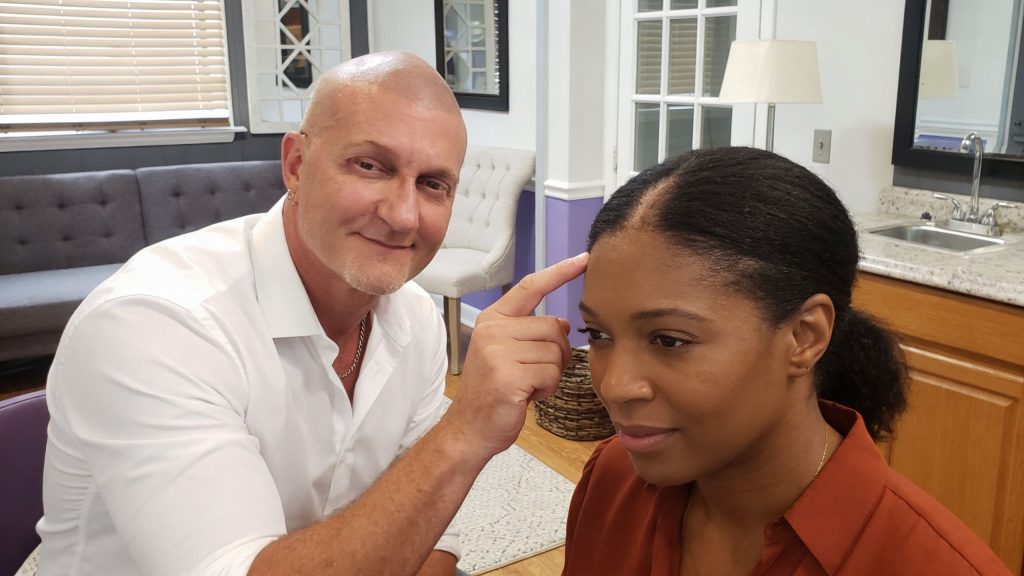
You’ve noticed your hairline creeping back, your temples looking thinner, and the edges that used to frame your face are simply gone. If years of braids, weaves, extensions, or tight ponytails are behind it, you’re dealing with traction alopecia. This article explains what SMP can do for women in exactly this situation, and what realistic results look like.
What traction alopecia actually does to your hairline
Traction alopecia is hair loss caused by repeated, sustained tension on the hair follicle. Tight braids, high ponytails, weaves, and extensions are the most common culprits. Over time, that constant pulling damages the follicle itself, and once the damage is deep enough, those hairs don’t come back.
The pattern is typically most visible at the temples and along the frontal hairline. You might notice a band of thinning just behind where your hair used to start, or bare patches at the sides that no longer respond to growth treatments. It’s one of the most common forms of hair loss from tight hairstyles, and it’s also one of the most emotionally loaded, because it’s tied directly to identity, culture, and the way you choose to present yourself.
For many women, the hairstyles that caused the damage weren’t just habits. They were expressions of heritage, profession, or simply how you felt most like yourself. That context matters, and it’s worth naming.
How SMP rebuilds density in thinning areas
SMP, scalp micropigmentation, deposits tiny, precise pigment impressions into the scalp that replicate the look of hair follicles. For women with traction alopecia, the technique adds density into thinning zones and re-establishes the visual line of the hairline. This is a density treatment, not a shaved-head effect.
Female SMP is applied to your existing hair. Your hair stays exactly as it is. The pigment works beneath and between your natural strands, filling in the gaps that traction alopecia has left behind. When you look in the mirror, the scalp no longer shows through, the hairline looks fuller, and the temples stop looking bare.
The result is subtle by design. Nobody should be able to tell you’ve had anything done, only that your hair looks thicker and your hairline looks more defined. That’s the whole point.
What the treatment process looks like for women
A typical SMP treatment for traction alopecia spans two to three sessions, spaced several weeks apart. The first session lays down the foundational pigment; subsequent sessions refine density, adjust tone, and ensure the result blends naturally with your existing hair colour.
The pigment is matched carefully to your natural hair colour and skin tone. For women with darker hair and deeper skin tones, a demographic where traction alopecia is particularly prevalent, getting that match right is one of the most important parts of the process. Done well, the pigment disappears into your hair at normal viewing distance and adds only to the overall impression of fullness.
There’s no shaving involved, no surgery, and no significant downtime. Most women return to normal activity within a day or two, avoiding intense sweating or direct sun exposure during the initial healing window.
Protecting your hairline after SMP
SMP addresses the appearance of traction alopecia beautifully, but it won’t stop further follicle damage if the underlying tension continues. Keeping your results looking their best means adjusting the hairstyles that caused the problem in the first place.
That doesn’t have to mean abandoning every style you love. Looser braids, lower-tension protective styles, and regular breaks from extensions all reduce the stress on follicles that are already compromised. Alternating the placement of ponytails and updos distributes tension more evenly and gives vulnerable areas a chance to recover.
SMP actually expands your styling options rather than restricting them. Because your temples and hairline look fuller, you’re no longer working around them. Styles that previously drew attention to thinning areas now look balanced and intentional. Many women find that having SMP done gives them the confidence to wear their hair up or pulled back again, something they’d avoided for years because of how their hairline looked.
If you’re also exploring treatments like PRP therapy or topical minoxidil alongside SMP, they work on different mechanisms and can complement each other. SMP improves the cosmetic appearance immediately; growth-stimulating treatments work on the follicle over time. The two aren’t in competition.
Frequently Asked Questions
Is SMP suitable for all skin tones in women with traction alopecia?
Yes. SMP works across the full range of skin tones, and an experienced practitioner will match the pigment carefully to both your skin tone and natural hair colour. For women with deeper complexions, a group where traction alopecia is particularly common, accurate pigment matching is essential and absolutely achievable with the right technique.
Will SMP damage the hair follicles that are still active?
No. SMP pigment is deposited into the uppermost layers of the scalp, well above the depth of the hair follicle. The technique doesn’t interfere with existing follicular activity, so any hair still growing in the treated area continues to grow normally. SMP and your natural hair coexist without conflict.
How long does SMP last on the hairline and temple area?
SMP typically remains looking sharp for three to five years before a refresh session is needed. Sun exposure is the main factor that causes pigment to fade faster, so applying SPF to exposed areas extends the result. Occasional top-up sessions keep the tone and density looking consistent as the years pass.
Can I still wear braids or extensions after having SMP?
You can, but it’s worth adjusting the tension and frequency to protect both the remaining follicles and the SMP result. Looser styles, lower installation tension, and regular breaks from extensions all help. Many women use SMP as a turning point to rethink their styling habits without feeling like they have to give up every look they enjoy.
What does hair loss from tight hairstyles look like compared to other types of hair loss?
Hair loss from tight hairstyles typically appears as a band of thinning along the frontal hairline and temples, often with small broken hairs at the margins. Unlike androgenetic hair loss, which tends to diffuse across the crown, traction alopecia follows the line of tension, making it highly recognisable to a practitioner experienced in treating it.